Monday, 2 December 2024

At the 30th edition of the Online Educa Berlin Conference

Together with colleagues from Eumetcal and EUMeTrain, I attended the 2024 edition of the Online Educa (OEB), the global conference that brings over 2000 education professionals to Berlin every year.

This year's focus was on the changes that transform the workplace and learning. Artificial Intelligence (AI) dominated most sessions. While in previous years AI was discussed more theoretically, this year participants were able to share practical experiences of using AI. While discussions showed progress, they did not appear groundbreaking to me; rather, they showed small, incremental steps forward, accompanied by enthusiasm, excitement and concerns. 


The Future of Work: Challenges and Opportunities

Several sessions focused on the future of work. I was happy to see the emphasis being placed on organisational objectives, strategies and gaps, answering key questions, such as ‘What problem are you trying to solve?’. The immense pressure to not fall behind in the AI revolution can sometimes lead to rushed decisions, prioritizing trends over strategic needs. We were advised to resist it. 

The pre-conference workshop on this topic was hosted by Speexx. Speexx supports professional development through structured mentorship and coaching. It provides tools and frameworks to help organisations implement effective mentoring programs that encourage skills growth, collaboration and employee engagement. Read about their mentorship programme which I found interesting.


Another hot topic was skills-based organisational transformation as a key approach for the future of work. This involves shifting from traditional role-based structures to task-focused frameworks that emphasises internal mobility. Steps include skill inventory management, evolving outdated skills, and redesigning roles to meet the needs of a dynamic work environment.


The speaker, Lori Niles, suggested that the interfaces of the future will be run by a single AI agenda which will change how we interact with information.


What does this mean for the L&D professional? In a panel discussion with management of various global organisations, a few points came across clearly:

  • If it’s about finding information, employees will find the content. Learning is outside the office. Stop focusing on the content. Focus on people.
  • Focus on conversations. Conversations over content means engaging with employees to learn about their needs and challenges; engaging with management on strategy. 
  • Help bridge the gap in your organisation between strategy and individual performance and development.


Great Minds on Learning: Insights from Donald Clark

As every year, the Donald Clark sessions were a personal favourite. Besides his AI- focused session, he hosted a live podcast recording on the Great Minds on Learning. Here he brought the attention to the historical evolution of learning theories and practices. His blog and podcast series offer digestible insights into education thinkers and concepts. Explore the podcasts here.


Reflections on Learning from Mistakes


Laura Overton and Charles Jennings hosted a session on the power of reflective thinking. Jennings, founder of the 70:20:10 Institute, highlighted the importance of key ingredients for learning: experience, practice, conversations and reflection.

Participants were invited to reflect and share in small groups on recent mistakes and lessons learned. This emphasised the importance of:

  • Trust and psychological safety as prerequisites for learning.
  • Research by Amy Edmondson, which stresses the need to embrace failure as part of growth. Read more on Edmondson’s research.

To support the exercise, Jennings shared the 3 Questions cards (see below).


Towards the end of the session, he also introduced another tool, the 505 Approach based on research suggesting that no change happens without management support both at the beginning and at the end of training interventions. 


Emerging tools and resources

While we cannot be certain how AI will shape the workplace, different jobs and tasks, it was argued that the technologies of the future will continue to seek and aim to deliver comfort, convenience, communication and connection.

One of the developments the learning community is excited about is expected in early 2025 from Gemini AI which will be able to analyse videos. This opens up exciting possibilities for assessments involving observation and performance analysis.


Interesting tools showcased at OEB2024:

  • Portfolio integration: Portflow integrates with Moodle and supports building portfolios
  • AI-powered lesson creation: Learnnetic and Adaptemy
  • Daily micro-training: Memacon provides daily training via WhatsApp
  • Content creation tools: Nolej AI, a free tool that simplifies content creation and delivery and Synthesia, AI-powered video creation
  • Engagement tools: Voice Threads facilitates multimedia-based discussions and Engageli, an interactive platform for collaborative learning
I’m particularly excited about tools like Nolej AI which transforms content to H5P interactions.


Other resources


As every year, one of the strengths of the event was its diverse range of formats that facilitate learning and networking. One notable absence for me this year was the buzz and engagement that typically accompanied the event on platforms like Twitter (now X), lately a lot less popular within the community.

To learn more, keep an eye on the conference website where recordings of various sessions will be made available.


Thursday, 20 April 2023

CALMet XV Conference 12-17 November 2023


CALMet XV was hosted by Deutscher Wetterdienst (DWD), Germany's National Meteorological Service, on 13-17 November 2023. 

CALMet XV was an event that brought together educators, trainers and managers from universities, research institutions, and National Meteorological and Hydrological Services. During the forum, participants shared experiences, expectations, and new ideas for applying emerging technologies and strategies in meteorology and hydrology education and training.

The conference was conducted fully online in both asynchronous and live format.

During the asynchronous pre-conference period (7-12 November 2023), the participants were able to familiarize themselves with the resources and activities provided by the authors.

The second week 13-17 November was mostly synchronous. Themed sessions gave the opportunity for the authors and the audience to meet and discuss. The session modes varied between full plenaries and smaller special interest group discussions.

View more 

Monday, 28 November 2022

Coming back to Online Educa Berlin in 2022

This November I had the pleasure to participate in person at the 28th annual global conference and exhibition on digital learning and training. The conference gathers annually thousands of learning professionals from 70+ countries. Despite being a global conference, it manages to maintain a cosy and friendly atmosphere, encouraging open discussions between education professionals from all sectors on shared opportunities, challenges and concerns.


OEB participation


As every year, the range of session formats included plenaries, presentation panels & debates to learning cafes, workshops, discovery demos and round table conversations.

Some of the most discussed topics included learning design & the human experience, making decisions with data, digital transformation, the metaverse & the future of learning, upskilling/reskilling & competences in the workplace.

Before discussing some of the sessions I participated in, here’s a quick list of useful links you may want to check out:

Pre-conference workshops

The first pre-conference workshop I attended was facilitated by Saul Carliner, Professor at Concordia University (Canada), who spoke about Curriculum design competency for L&D professionals. Using the Competency framework for L&D professionals developed by the Institute for Performance and Learning (Canada), we worked in groups to address the challenge: design curriculums for higher education, continuing education and corporate training. In our designs, we were prompted to address the following elements: curriculum requirements & potential issues, a list of courses we may want to include, as well as information that has to go in the curriculum proposal.


Saul Carliner on Curriculum design 

The second workshop of the day was offered by Carol Damm (Boston College, USA) and Melissa Kane (Brown University, USA). Entitled “Designing Humanistic Learning Experiences for Education, Training and Product Development”, the session aimed to engage participants in co-designing a framework redefining humanistic learner experiences for education, training or product development.

After an introductory exercise, the facilitators introduced the head - heart – hands perspective.

The head - heart – hands method & learning sciences

Next, the concept of Human-centered design was introduced and discussed from different perspectives/fields including industrial design, user experience design, anthropology and game design (see the images below).

After this introduction, we were split in groups and invited to select a case study and design a framework integrating the humanistic concepts introduced in the session.


Human-centered design from various perspectives

Opening plenary on 1st day of the conference

On the first day of the conference, the plenary was kicked off by David Mattin, journalist and founder of the New World Same Humans (UK), a newsletter on trends, technology and society. His talk focused on the capabilities of Virtual reality and AI, with impressive applications, such as a recent complex 27-hour surgery in Rio de Janeiro directed from a hospital in London. The almost 100 medical staff involved operated in the same "virtual reality room" together.

Another example was Replika, a controversial chatbot that simulates a human relationship powered by artificial intelligence (AI), combining a sophisticated neural network machine learning model and scripted dialogue content - GPT-3 – giving users the impression of being heard and understood.

Here is a recent interview with David where he talks about his work.

 Replika or the risks of advanced chatbots

Also in the opening plenary, Pär Lager (Swedish Defence University) spoke about how leaders should focus on what their organisations will look like in 5-10 years from now and how roles will change. The main points shared was that for roles which will stay, upskilling will be necessary, as they will become more complex. A series of new roles will also appear in organisations, making reskilling required - equipping staff with new knowledge and abilities. To do that, Pär suggested 5 steps for creating a successful learning culture:

1. Light the lighthouse – where are we as an organisation headed towards?
2. Learning mindset – when leaders embrace the need for learning it results in greater growth in their teams
3. Learning needs & learning policy – find out what the teams need and instill learning best practices into their organisation
4. Everyday learning - leaders who encourage learning before, after and on the job experience the greatest success
5. Education & training - create opportunities for in-depth learning through formal opportunities

More information on his approach is available in this article published on the Oslo Business Forum. 

enABLe – Active Blended Learning method for collaborative learning design

One of the most interactive sessions at the conference for me was Ale Armellini and Andy Cleff’s (University of Portsmouth, UK) learning café which introduced the enABLe method. The method builds on UCL’s ABC Learning Design method (see my 2019 post), as well as on Gilly Sander’s Carpe Diem and University of Northampton’s CAleRO method. The core principles of th emethod are detailed on the enABLe website. If you are interested in the application of the method, have a look at this Padlet. All resources there are available for download and licensed with Creative Commons.

Professor Ale Armellini introducing the enABLe principles

The 90-minute session at OEB was conceived as a team-building exercise to learning design using a series of activities, such as the articulation of our shared values and principles and a step-by-step collaborative approach to storyboarding and activity creation. It was fun, intuitive and unlike many other similar workshops, well scoped for the limited time we had together. See the slides.

The enABLe toolkit

Donald Clark on what research tells us about the Metaverse

One of the most exciting session was Donald Clark’s talk “Learning in VR and the Metaverse: Practical Pointers Based on the Research”. Donald took the audience through a history of learning from cave art to printing, touching upon the massive success of video games, the inevitable shift from 2D to 3D and the use of Virtual Reality (VR).

He continued by asking a number of important questions, such as, does VR increase learning? Does it lead to better learning? Does generative learning work in VR or does embodied learning matter? What about learning by doing and very importantly, to what extent is cognitive load a problem in VR?

To answer such questions he drew on older and more recent research, from the work of Richard Clark (2007) on games, discovery learning and cognitive overload to Guido Makransky’s recent work at the Virtual Learning Lab at the University of Copenhagen, who developed a research model for learning in immersive media taking into consideration factors such as interest, motivation, self-efficacy, embodiment, cognitive load and self-regulation.

Donald Clark on stage

If you need an introduction to the Metaverse, listen to this episode of Great Minds on Learning: VR & Metaverse with Donald Clark, a discussion conducted in a virtual world exploring “the thought of those who have tackled the practical and philosophical questions that learning in virtual worlds raises” from Lanier to Baudrillard and Mark Zuckerberg.

You may also be interested in his latest book Learning Experience Design: How to Create Effective Learning that Works from 2021 where Donald includes a reflection on a variety of topics from user experience to AI, learning analytics and learning theories.

He is active on his blog.

How to use Learning design & analytics in your own practice?

Bart Rienties from the Open University (UK) talked about their large scale adoption of predictive learning analytics at the OU since 2014. Integrating the Balanced Design Planning (BDP) created by the Learning Analytics Laboratory (LA Lab) from the University of Zagreb, the Open University makes use of an analytics dashboard tracking demographic data, time spent, use of resources, completion of activities, number of clicks, correlation with grades etc.

While such analytics can often predict with success course completion rates and future engagement, it’s still an open discussion to what extent they reveal useful information about learning; and to what extent this information can and should be used to inform course design and learner experience.

Access the slides here.

Open University on challenges from working with predictive learning analytics


For more on OEB, check out #oeb2022 on Twitter and keep an eye on the resources available at their website. 


Wednesday, 2 June 2021

Welcome to CALMet XIV!


CALMet XIV 

27 September - 1 October, 2021 

Online, hosted by Servicio Meteorológico Nacional, Argentina

Third Announcement 


Conference registration is now closed.
 

If you have any questions please contact: organizers@calmet.org


Friday, 5 March 2021

CALMet XIV 2021 - Second Announcement


 CALMet XIV will be hosted by Servicio Meteorológico Nacional, Argentina, on 27 September - 1 October 2021. This entirely online conference will offer a venue to find what we have learned and what future impacts this will have for the hydro-meteorological training. It will also encourage practitioners in the education and training sector to discuss, debate and share views and techniques on the challenges / opportunities arising from the following sub-themes: Education and Training Challenges and Opportunities,
Online Teaching and Learning, Collaboration.


In 2021 CALMet will offer a new, more active event - a “flipped-learning conference.” Rather than a series of presentations, we intend this event to be highly active and filled with opportunities for participants to interact. This is because we are asking for the presentation materials to be posted and reviewed in advance, leaving the valuable conference time to probe, question and discuss more than ever before. The Second Announcement is now available for more information and abstract submission.

Read the Second Announcement   

Monday, 23 November 2020

 I am presenting the linked presentation next week at the 2020 Online Educa Berlin Conference. "Trainers Without Borders" is about what trainers can do to have even deeper impacts with our learners.

I have believed for a long time that training is more than what happens in classrooms, and more than what is controlled by trainers. It is an everyday, all day, lifetime activity. What we know is the result of our interactions with not just educators, but also our colleagues and our living and working environments each day. Research supports this again and again, as well as everyday parlance ("live and learn," "experience is the best teacher," "learning by doing").  Trainers have an opportunity here: we can cross borders and impact learners in more ways than is traditional. If we try, we can build learning ecosystems, not just courses. We can create sustainable learning.

The presentation linked here explores the trajectory of learning theories through history, toward a convergence on ecological perspectives, driven by increased emphasis on systems theory and complexity. Principles of ecological theories and applications in our CALMet communities are also offered.

https://youtu.be/y7KcJgfW9Nk

Monday, 11 May 2020

Let’s learn from each other!!

Sometimes you happen to be part of a great WhatsApp group that is called Design Discussions where some invitations for good webinars came by. We shared these invitations with the community. Then I was pushed by the Eumetcal community to put all the available resources from these webinars on one easy to find place. For me this was the trigger to create a “Support for the community” page on the CALMet Commons with all the great resources that were shared between the members in the WhatsApp Design Discussions group and were found in the rest of the community. 

Our plan is to keep this page updated with the new resources we find. Therefore we hope that you will also share with me your suggestions for training material, articles, books and tools which makes your live easier and could be handy for others within our community to use as well. Then I will make sure that this information will be put on the page. In the end we hope that this will help to make your job easier.

Friday, 6 December 2019

My time at Online Educa Berlin 2019

This past November I had the privilege to attend the Online Educa Berlin (OEB) 2019 annual conference. It's a privilege really, as these conference are not cheap, considering besides fees, the time away from the office and the alternative: free, online excellent resources and events (see the ALT Online Winter Conference 2019 or the Open Education Week). I go to OEB for the few, but excellent sessions that encourage critical thinking, the a-ha moments or, according to the Brain Ladies, the light bulb moments when gamma waves activity supports intensive bursts of higher-order thinking. 
The light bulb moment for me this year happened during: 
  • Audrey Watters’ keynote - on edtech propaganda, dystopian futures, ideology and myths. Audrey sees herself as a Kassandra of the edtech world and writes nicely at http://hackeducation.com;
  • Mike Sharples' session - drawing on his Open University (OU) experience or that of designing FutureLearn, he talked about pedagogy-based design, citizen inquiry, promoted his new book, Practical Pedagogy, and the annual OU Innovating Pedagogy reports, a correspondent of the EDUCAUSE's Horizon Reports;
  • Brain Ladies' lively, humorous and playful session from 4 researcher ladies on neuro-science, AI and learning. Online workshops to be offered starting next January;
  • Nik Gowing's scary session on thinking the unthinkable reflecting the findings of his study on leadership, global anxieties and disruptions (read more on that). At OEB, Nik warned educators  about the necessity to prepare for what is to come - the unforeseeable.
  • Donald Clark sessions on both the pedagogy behind videos (or why they are not enough for deep learning) and predictable AI sessions, while promoting some of his AI or sort of AI work, see CogBooks. His talk was preceded by a lovely presentation by Mathew Day from ESA who showed us how they've been using videos to train astronauts up at the International Space Station.

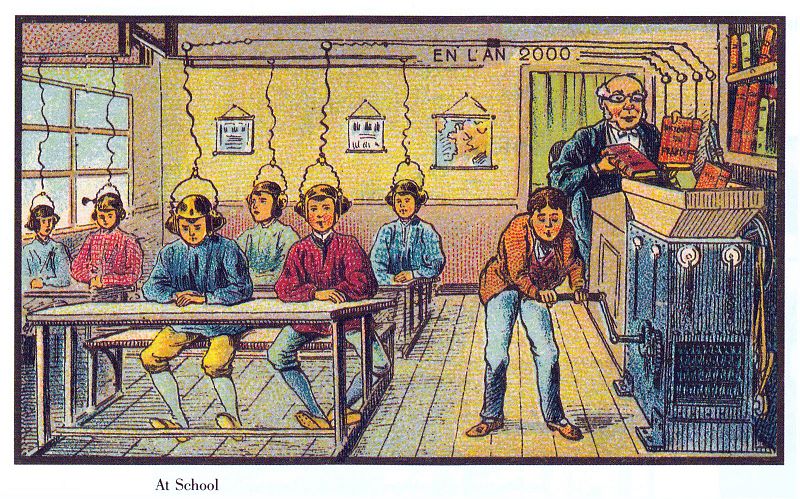
Jean-Marc Côté, A 19th-Century Vision of the Year 2000
On the first day (pre-conference), I attended a whole day Design Thinking workshop at the prestigious HPI Design thinking school. The challenge: Envision and design Post-Disciplinary Learning: Rethinking Educational Systems in a world where there are no more disciplines. We worked through a 2-phase process, first Problem Space (Understand + Observe + Point of View) and then Solution Space (Ideation, Prototyping and Test), brainstorming, interviewing, analysing, clustering, prototyping and so on. You can learn more about the methodology here and do consider it if you are dealing with complex challenges where potentially disruptive, multi-disciplinary approaches/solutions are needed. Keep in mind thought that an experienced facilitator is key to Design thinking. 

In my past work, I had the opportunity to work with the Institute for the Study of Knowledge Management, ISKME (California) which delivers what they call Action Collabs and I must say that their version of a design thinking workshop felt more conducive to the sort of creative thinking that leads to innovating ideas. The Berlin facilitation version focused too much on the rigour of the process, instead of supporting the creative flow.
Moving on, what else drew my attention?

OEB 2019 - Official Wrap-up video 
On the last day, I dropped into the Blended Learning design session delivered by Nataša Perović and Clive Young from the University College London (UK). The room was full of excitement. They spoke about the same ABC methodology I had learned from them at OEB 2017. ABC is a visual storyboard approach for designing blended curriculums and it has in the past 2 years been used successfully various time in the meteorological training community. 
The final session of the day for me, Learning cultures, emphasised an old, but important idea - how we, those working in learning and design need to stop acting like a hammer looking for a nail, but instead act as partners, working closely with those we are trying to serve; with a broad ecosystem approach in mind where training is not an universal panacea. 
For more of an impression of the conversations that go on back at forth over the years at & around OEB such as if and to what extent we are ready to work with AI, if we are teaching the right skills for the future, and the role of workplace learning, check out #oeb2019 on Twitter. 
How did others experience OEB2019?
  • See Audrey Watter's reflection
  • Donald Clark's reflection
  • ... and I can't wait to read Tomislav Marekovic's reflection, my colleague from EUMETCAL who came along.