Showing posts with label learning solutions. Show all posts

Monday, 23 November 2020

 I am presenting the linked presentation next week at the 2020 Online Educa Berlin Conference. "Trainers Without Borders" is about what trainers can do to have even deeper impacts with our learners.

I have believed for a long time that training is more than what happens in classrooms, and more than what is controlled by trainers. It is an everyday, all day, lifetime activity. What we know is the result of our interactions with not just educators, but also our colleagues and our living and working environments each day. Research supports this again and again, as well as everyday parlance ("live and learn," "experience is the best teacher," "learning by doing").  Trainers have an opportunity here: we can cross borders and impact learners in more ways than is traditional. If we try, we can build learning ecosystems, not just courses. We can create sustainable learning.

The presentation linked here explores the trajectory of learning theories through history, toward a convergence on ecological perspectives, driven by increased emphasis on systems theory and complexity. Principles of ecological theories and applications in our CALMet communities are also offered.

https://youtu.be/y7KcJgfW9Nk

Tuesday, 19 August 2014

MOOC format continues to make waves...

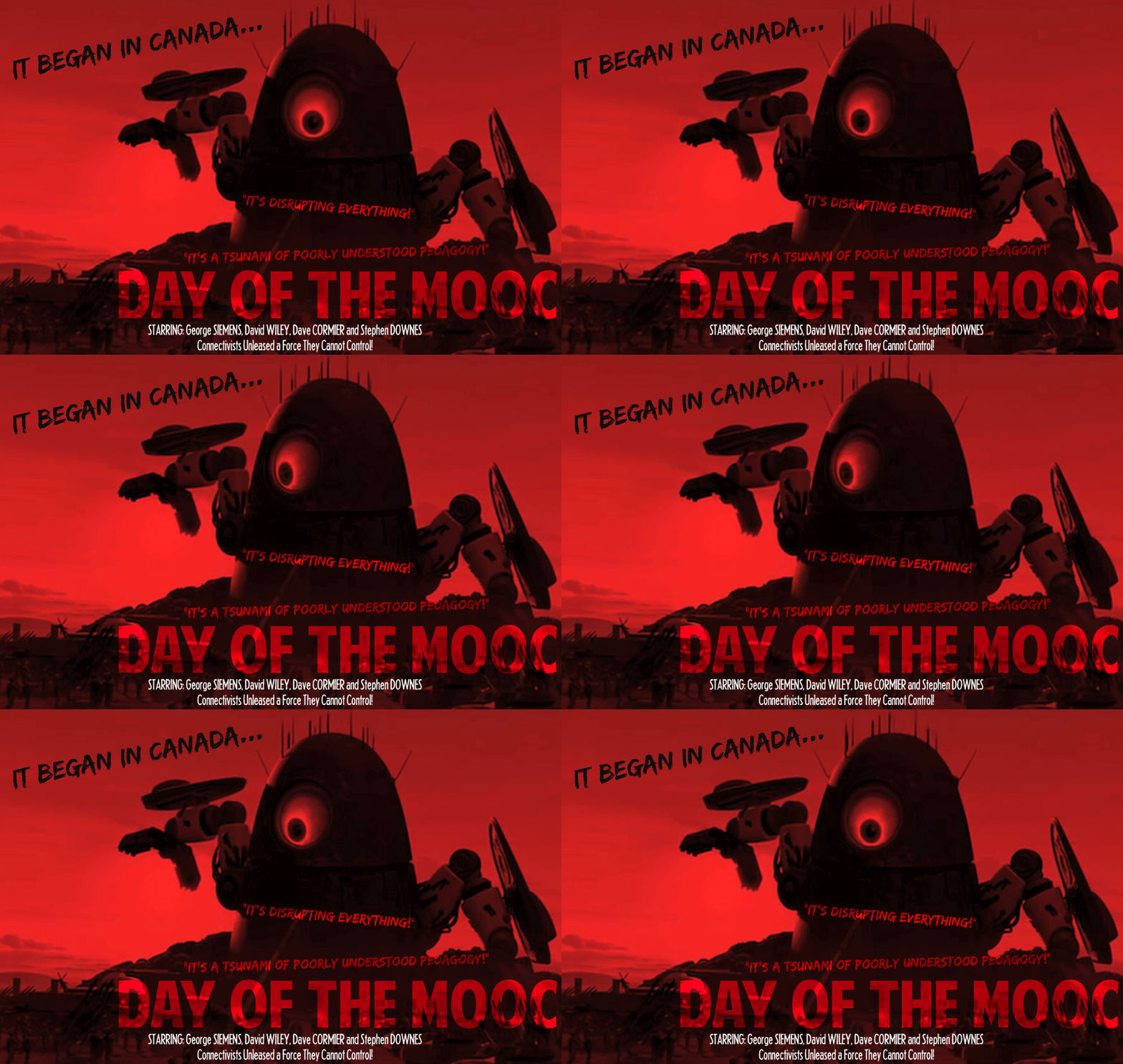
"Day of the MOOC" by mbransons
The MOOC (Massive Open Online Couse) format continues to make waves due to the excitement that its reach and innovative use of new internet technologies generates. MOOCs have been around for over 5 years and their popularity among practitioners and theorists, as well as academic institutions, seems to continue growing. More data, statistics and thoughts have been collected since last summer, when CALMet Commons hosted our article about MOOCs (How much OOOO in your MOOC?). That is also why we decided to update it. We are happy to share that the refined version of the article was recently published in the academic journal for distance education - Form@re, edited by University of Florence.

The second version explores even more current trends in MOOC offerings, questioning the pedagogical value of the new implementations, but also appreciating their rapid growth and potential impact. The article suggests that MOOCs should be adopted with conscious and deliberate intent to utilize the openness the form allows, and not simply because they reach more students.

For Italian speaking readers, if you are interested in MOOCs and OER the last issue of Form@re offers other valuable articles.

Sunday, 20 July 2014

Learnopoly - a game of learning activities

Learnopoly is a game created for exercising skills for instructional design, where competing teams of players race to design learning activities for a set of given topics. Design constraints are determined randomly, by dealing cards and spinning a wheel. The cards decide the topic and type of activity that must be designed, and the spin decides the learning solution--whether the activity will be carried out either synchronously online, asynchronously online, or in a classroom. The purpose of the game is to offer a creative challenge to players to use different learning activities for different learning solutions in effective and engaging ways. Too often we chose learning solutions only because we have tried them already and are comfortable with them. Learnopoly offers a safe and entertaining environment where players have the opportunity to challenge themselves to think out of the box.


Learnopoly was introduced as a workshop activity at the recent 2014 Eumetcal Workshop held in Warsaw, Poland, from 10 to 13 June. Over 30 players tried out the game, successfully came up with a great set of solutions, and provided useful feedback for improvements.

Spin the wheel


Real life puts constraints on our training projects, usually for good reasons, but not always. In Learnopoly these constraints are determined randomly, which frees (or forces) participants to prepare themselves for those situations in which they will need or want to attempt something different. 

After an introduction to the goals and basic rules, the following game items were distributed to each team:
  • Two sets of cards - Learning activities and Topics (job responsibilities requiring training). Learning activities ranged from discussions to simulations. The topics were varied to cater to a range of a team member expertise, from aeronautical forecasting to disaster response.
  • Learning Solution Spinner - The spinner randomly selected the Classroom, an Online synchronous course, or an Online asynchronous course as the context for the learning activity.
  • Answer sheets to be used by the teams to describe the learning activities they created, according to stated criteria and to achieve a learning outcome appropriate for the selected Topic on one of their cards.
  • A board that helped the team track the points awarded and combinations of Learning activities and Learning solutions used. Some combinations earned bonus points.

The player goals were to beat the time constraints and the other teams in coming up with the most and best learning activities. How were the winners chosen? There were two official ways to win, two goals to accomplish:
1) Design the most learning activities in the time allotted and collect the most points. A team was lucky if it randomly chose a combination of a Learning activity and Learning solution that granted them the opportunity to earn bonus points.
2) Design the best (most effective and engaging) learning activity. These were voted by the other teams at the end of the session, after each team nominated one of the activities they had created and described it aloud.

Nightmare on the shift