Showing posts with label conference. Show all posts

Monday, 2 December 2024

At the 30th edition of the Online Educa Berlin Conference

Together with colleagues from Eumetcal and EUMeTrain, I attended the 2024 edition of the Online Educa (OEB), the global conference that brings over 2000 education professionals to Berlin every year.

This year's focus was on the changes that transform the workplace and learning. Artificial Intelligence (AI) dominated most sessions. While in previous years AI was discussed more theoretically, this year participants were able to share practical experiences of using AI. While discussions showed progress, they did not appear groundbreaking to me; rather, they showed small, incremental steps forward, accompanied by enthusiasm, excitement and concerns. 


The Future of Work: Challenges and Opportunities

Several sessions focused on the future of work. I was happy to see the emphasis being placed on organisational objectives, strategies and gaps, answering key questions, such as ‘What problem are you trying to solve?’. The immense pressure to not fall behind in the AI revolution can sometimes lead to rushed decisions, prioritizing trends over strategic needs. We were advised to resist it. 

The pre-conference workshop on this topic was hosted by Speexx. Speexx supports professional development through structured mentorship and coaching. It provides tools and frameworks to help organisations implement effective mentoring programs that encourage skills growth, collaboration and employee engagement. Read about their mentorship programme which I found interesting.


Another hot topic was skills-based organisational transformation as a key approach for the future of work. This involves shifting from traditional role-based structures to task-focused frameworks that emphasises internal mobility. Steps include skill inventory management, evolving outdated skills, and redesigning roles to meet the needs of a dynamic work environment.


The speaker, Lori Niles, suggested that the interfaces of the future will be run by a single AI agenda which will change how we interact with information.


What does this mean for the L&D professional? In a panel discussion with management of various global organisations, a few points came across clearly:

  • If it’s about finding information, employees will find the content. Learning is outside the office. Stop focusing on the content. Focus on people.
  • Focus on conversations. Conversations over content means engaging with employees to learn about their needs and challenges; engaging with management on strategy. 
  • Help bridge the gap in your organisation between strategy and individual performance and development.


Great Minds on Learning: Insights from Donald Clark

As every year, the Donald Clark sessions were a personal favourite. Besides his AI- focused session, he hosted a live podcast recording on the Great Minds on Learning. Here he brought the attention to the historical evolution of learning theories and practices. His blog and podcast series offer digestible insights into education thinkers and concepts. Explore the podcasts here.


Reflections on Learning from Mistakes


Laura Overton and Charles Jennings hosted a session on the power of reflective thinking. Jennings, founder of the 70:20:10 Institute, highlighted the importance of key ingredients for learning: experience, practice, conversations and reflection.

Participants were invited to reflect and share in small groups on recent mistakes and lessons learned. This emphasised the importance of:

  • Trust and psychological safety as prerequisites for learning.
  • Research by Amy Edmondson, which stresses the need to embrace failure as part of growth. Read more on Edmondson’s research.

To support the exercise, Jennings shared the 3 Questions cards (see below).


Towards the end of the session, he also introduced another tool, the 505 Approach based on research suggesting that no change happens without management support both at the beginning and at the end of training interventions. 


Emerging tools and resources

While we cannot be certain how AI will shape the workplace, different jobs and tasks, it was argued that the technologies of the future will continue to seek and aim to deliver comfort, convenience, communication and connection.

One of the developments the learning community is excited about is expected in early 2025 from Gemini AI which will be able to analyse videos. This opens up exciting possibilities for assessments involving observation and performance analysis.


Interesting tools showcased at OEB2024:

  • Portfolio integration: Portflow integrates with Moodle and supports building portfolios
  • AI-powered lesson creation: Learnnetic and Adaptemy
  • Daily micro-training: Memacon provides daily training via WhatsApp
  • Content creation tools: Nolej AI, a free tool that simplifies content creation and delivery and Synthesia, AI-powered video creation
  • Engagement tools: Voice Threads facilitates multimedia-based discussions and Engageli, an interactive platform for collaborative learning
I’m particularly excited about tools like Nolej AI which transforms content to H5P interactions.


Other resources


As every year, one of the strengths of the event was its diverse range of formats that facilitate learning and networking. One notable absence for me this year was the buzz and engagement that typically accompanied the event on platforms like Twitter (now X), lately a lot less popular within the community.

To learn more, keep an eye on the conference website where recordings of various sessions will be made available.


Monday, 28 November 2022

Coming back to Online Educa Berlin in 2022

This November I had the pleasure to participate in person at the 28th annual global conference and exhibition on digital learning and training. The conference gathers annually thousands of learning professionals from 70+ countries. Despite being a global conference, it manages to maintain a cosy and friendly atmosphere, encouraging open discussions between education professionals from all sectors on shared opportunities, challenges and concerns.


OEB participation


As every year, the range of session formats included plenaries, presentation panels & debates to learning cafes, workshops, discovery demos and round table conversations.

Some of the most discussed topics included learning design & the human experience, making decisions with data, digital transformation, the metaverse & the future of learning, upskilling/reskilling & competences in the workplace.

Before discussing some of the sessions I participated in, here’s a quick list of useful links you may want to check out:

Pre-conference workshops

The first pre-conference workshop I attended was facilitated by Saul Carliner, Professor at Concordia University (Canada), who spoke about Curriculum design competency for L&D professionals. Using the Competency framework for L&D professionals developed by the Institute for Performance and Learning (Canada), we worked in groups to address the challenge: design curriculums for higher education, continuing education and corporate training. In our designs, we were prompted to address the following elements: curriculum requirements & potential issues, a list of courses we may want to include, as well as information that has to go in the curriculum proposal.


Saul Carliner on Curriculum design 

The second workshop of the day was offered by Carol Damm (Boston College, USA) and Melissa Kane (Brown University, USA). Entitled “Designing Humanistic Learning Experiences for Education, Training and Product Development”, the session aimed to engage participants in co-designing a framework redefining humanistic learner experiences for education, training or product development.

After an introductory exercise, the facilitators introduced the head - heart – hands perspective.

The head - heart – hands method & learning sciences

Next, the concept of Human-centered design was introduced and discussed from different perspectives/fields including industrial design, user experience design, anthropology and game design (see the images below).

After this introduction, we were split in groups and invited to select a case study and design a framework integrating the humanistic concepts introduced in the session.


Human-centered design from various perspectives

Opening plenary on 1st day of the conference

On the first day of the conference, the plenary was kicked off by David Mattin, journalist and founder of the New World Same Humans (UK), a newsletter on trends, technology and society. His talk focused on the capabilities of Virtual reality and AI, with impressive applications, such as a recent complex 27-hour surgery in Rio de Janeiro directed from a hospital in London. The almost 100 medical staff involved operated in the same "virtual reality room" together.

Another example was Replika, a controversial chatbot that simulates a human relationship powered by artificial intelligence (AI), combining a sophisticated neural network machine learning model and scripted dialogue content - GPT-3 – giving users the impression of being heard and understood.

Here is a recent interview with David where he talks about his work.

 Replika or the risks of advanced chatbots

Also in the opening plenary, Pär Lager (Swedish Defence University) spoke about how leaders should focus on what their organisations will look like in 5-10 years from now and how roles will change. The main points shared was that for roles which will stay, upskilling will be necessary, as they will become more complex. A series of new roles will also appear in organisations, making reskilling required - equipping staff with new knowledge and abilities. To do that, Pär suggested 5 steps for creating a successful learning culture:

1. Light the lighthouse – where are we as an organisation headed towards?
2. Learning mindset – when leaders embrace the need for learning it results in greater growth in their teams
3. Learning needs & learning policy – find out what the teams need and instill learning best practices into their organisation
4. Everyday learning - leaders who encourage learning before, after and on the job experience the greatest success
5. Education & training - create opportunities for in-depth learning through formal opportunities

More information on his approach is available in this article published on the Oslo Business Forum. 

enABLe – Active Blended Learning method for collaborative learning design

One of the most interactive sessions at the conference for me was Ale Armellini and Andy Cleff’s (University of Portsmouth, UK) learning café which introduced the enABLe method. The method builds on UCL’s ABC Learning Design method (see my 2019 post), as well as on Gilly Sander’s Carpe Diem and University of Northampton’s CAleRO method. The core principles of th emethod are detailed on the enABLe website. If you are interested in the application of the method, have a look at this Padlet. All resources there are available for download and licensed with Creative Commons.

Professor Ale Armellini introducing the enABLe principles

The 90-minute session at OEB was conceived as a team-building exercise to learning design using a series of activities, such as the articulation of our shared values and principles and a step-by-step collaborative approach to storyboarding and activity creation. It was fun, intuitive and unlike many other similar workshops, well scoped for the limited time we had together. See the slides.

The enABLe toolkit

Donald Clark on what research tells us about the Metaverse

One of the most exciting session was Donald Clark’s talk “Learning in VR and the Metaverse: Practical Pointers Based on the Research”. Donald took the audience through a history of learning from cave art to printing, touching upon the massive success of video games, the inevitable shift from 2D to 3D and the use of Virtual Reality (VR).

He continued by asking a number of important questions, such as, does VR increase learning? Does it lead to better learning? Does generative learning work in VR or does embodied learning matter? What about learning by doing and very importantly, to what extent is cognitive load a problem in VR?

To answer such questions he drew on older and more recent research, from the work of Richard Clark (2007) on games, discovery learning and cognitive overload to Guido Makransky’s recent work at the Virtual Learning Lab at the University of Copenhagen, who developed a research model for learning in immersive media taking into consideration factors such as interest, motivation, self-efficacy, embodiment, cognitive load and self-regulation.

Donald Clark on stage

If you need an introduction to the Metaverse, listen to this episode of Great Minds on Learning: VR & Metaverse with Donald Clark, a discussion conducted in a virtual world exploring “the thought of those who have tackled the practical and philosophical questions that learning in virtual worlds raises” from Lanier to Baudrillard and Mark Zuckerberg.

You may also be interested in his latest book Learning Experience Design: How to Create Effective Learning that Works from 2021 where Donald includes a reflection on a variety of topics from user experience to AI, learning analytics and learning theories.

He is active on his blog.

How to use Learning design & analytics in your own practice?

Bart Rienties from the Open University (UK) talked about their large scale adoption of predictive learning analytics at the OU since 2014. Integrating the Balanced Design Planning (BDP) created by the Learning Analytics Laboratory (LA Lab) from the University of Zagreb, the Open University makes use of an analytics dashboard tracking demographic data, time spent, use of resources, completion of activities, number of clicks, correlation with grades etc.

While such analytics can often predict with success course completion rates and future engagement, it’s still an open discussion to what extent they reveal useful information about learning; and to what extent this information can and should be used to inform course design and learner experience.

Access the slides here.

Open University on challenges from working with predictive learning analytics


For more on OEB, check out #oeb2022 on Twitter and keep an eye on the resources available at their website. 


Friday, 6 December 2019

My time at Online Educa Berlin 2019

This past November I had the privilege to attend the Online Educa Berlin (OEB) 2019 annual conference. It's a privilege really, as these conference are not cheap, considering besides fees, the time away from the office and the alternative: free, online excellent resources and events (see the ALT Online Winter Conference 2019 or the Open Education Week). I go to OEB for the few, but excellent sessions that encourage critical thinking, the a-ha moments or, according to the Brain Ladies, the light bulb moments when gamma waves activity supports intensive bursts of higher-order thinking. 
The light bulb moment for me this year happened during: 
  • Audrey Watters’ keynote - on edtech propaganda, dystopian futures, ideology and myths. Audrey sees herself as a Kassandra of the edtech world and writes nicely at http://hackeducation.com;
  • Mike Sharples' session - drawing on his Open University (OU) experience or that of designing FutureLearn, he talked about pedagogy-based design, citizen inquiry, promoted his new book, Practical Pedagogy, and the annual OU Innovating Pedagogy reports, a correspondent of the EDUCAUSE's Horizon Reports;
  • Brain Ladies' lively, humorous and playful session from 4 researcher ladies on neuro-science, AI and learning. Online workshops to be offered starting next January;
  • Nik Gowing's scary session on thinking the unthinkable reflecting the findings of his study on leadership, global anxieties and disruptions (read more on that). At OEB, Nik warned educators  about the necessity to prepare for what is to come - the unforeseeable.
  • Donald Clark sessions on both the pedagogy behind videos (or why they are not enough for deep learning) and predictable AI sessions, while promoting some of his AI or sort of AI work, see CogBooks. His talk was preceded by a lovely presentation by Mathew Day from ESA who showed us how they've been using videos to train astronauts up at the International Space Station.

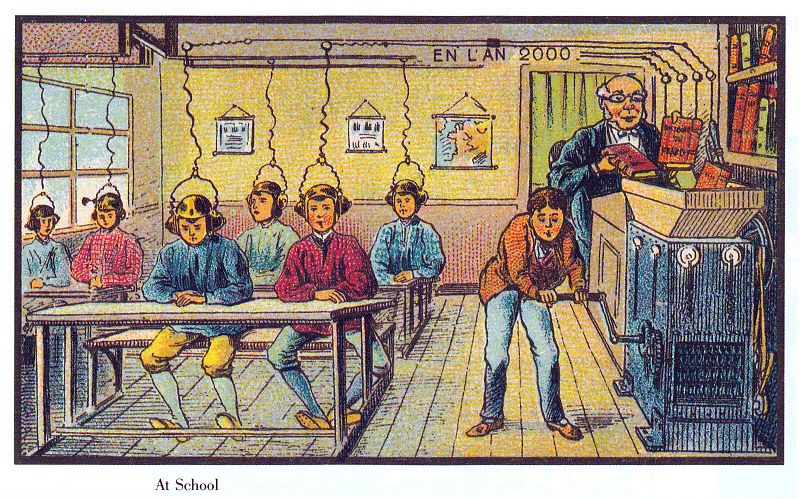
Jean-Marc Côté, A 19th-Century Vision of the Year 2000
On the first day (pre-conference), I attended a whole day Design Thinking workshop at the prestigious HPI Design thinking school. The challenge: Envision and design Post-Disciplinary Learning: Rethinking Educational Systems in a world where there are no more disciplines. We worked through a 2-phase process, first Problem Space (Understand + Observe + Point of View) and then Solution Space (Ideation, Prototyping and Test), brainstorming, interviewing, analysing, clustering, prototyping and so on. You can learn more about the methodology here and do consider it if you are dealing with complex challenges where potentially disruptive, multi-disciplinary approaches/solutions are needed. Keep in mind thought that an experienced facilitator is key to Design thinking. 

In my past work, I had the opportunity to work with the Institute for the Study of Knowledge Management, ISKME (California) which delivers what they call Action Collabs and I must say that their version of a design thinking workshop felt more conducive to the sort of creative thinking that leads to innovating ideas. The Berlin facilitation version focused too much on the rigour of the process, instead of supporting the creative flow.
Moving on, what else drew my attention?

OEB 2019 - Official Wrap-up video 
On the last day, I dropped into the Blended Learning design session delivered by Nataša Perović and Clive Young from the University College London (UK). The room was full of excitement. They spoke about the same ABC methodology I had learned from them at OEB 2017. ABC is a visual storyboard approach for designing blended curriculums and it has in the past 2 years been used successfully various time in the meteorological training community. 
The final session of the day for me, Learning cultures, emphasised an old, but important idea - how we, those working in learning and design need to stop acting like a hammer looking for a nail, but instead act as partners, working closely with those we are trying to serve; with a broad ecosystem approach in mind where training is not an universal panacea. 
For more of an impression of the conversations that go on back at forth over the years at & around OEB such as if and to what extent we are ready to work with AI, if we are teaching the right skills for the future, and the role of workplace learning, check out #oeb2019 on Twitter. 
How did others experience OEB2019?
  • See Audrey Watter's reflection
  • Donald Clark's reflection
  • ... and I can't wait to read Tomislav Marekovic's reflection, my colleague from EUMETCAL who came along. 


Friday, 4 December 2015

The future of work and learning


Photo by LandOreports
The final day of Online Educa Berlin continued with challenging, but even more diverse offerings. One of the best sessions was on “Future Work and Future Workers.” Several futurists posed their visions of how the world of work is changing. There seems to be little doubt that, without a major natural or other disruption to progress, artificial intelligence (AI) and robotics will reduce the human contributions to many tasks. Some jobs will be changed and some will fade away. One presenter thought technology-enhanced jobs will be the most common change, where AI and other tools will just modify and improve what we already do. Another felt that many jobs will disappear, and that it is too soon to see how people will adapt to the change. Can all the replaced people become knowledge workers? Unlikely, based on current definitions of that term, but in a world of connected knowledge, perhaps we all have a place.

All seemed to feel that work has already changed. Work is now more interconnected, multidisciplinary, multi-generational, freelance, and project-oriented. The days of having a single job are fading—we increasingly fill many roles and may eventually all become entrepreneurs. The workplace of the future (already here for many) will be spread over multiple locations, if not ubiquitous. We can all contribute from anywhere and at anytime using tools already available.

The world of learning is also changing rapidly. Virtual reality workshops could become a radical disrupter and challenge those most die hard in insisting on the need for classroom training. People are learning new skills each day via YouTube videos. Do you want your doctor trained this way? Maybe a better question is, if this is where they can learn new techniques quickly, do you want them to NOT use them?

What skills are most required in this new world of work? In addition to technical skills, some posed were
  • Analytical skills
  • Intuition (creative) skills
  • Information brokering
  • Multi-cultural perspectives
  • Multi-disciplinary flexibility
Concerns were raised that the rapid pace of change is counter productive, and some warned that if we do not make it a habit to slow down, we might lose too much of our humanity.

At a session dedicated to participants from UN agencies, 23 participants discussed challenges to training design, development, and delivery. Concerns were raised about the need for faster, agile instructional design processes. In a discussion about uses of blended learning, it was clear that the term has many meanings. Many saw that at least 3 phases are needed—an online course phase, followed by a classroom phase, completed by a mentoring phase. (This was heartening to see!) Others talked about using a variety of tools and modes in the blend, not just single conceptions of “online.” We shared the tools we use, and agreed to keep a community together as much as possible to share experiences and strategies. ECBCheck, a quality management system for online learning, will be taught in a MOOC starting 15 February,2016.

In a session on learning analytics, the challenges of sorting through piles of data to turn them into useful information for diagnosis and prediction to improve learning was highlighted. In university settings, they are first tackling the task of gathering analytical data for predicting positive learning experiences, engagement and completion. Decision makers want single indices to use as predictors to help learners at risk, but with so many contributing factors, this is difficult. Learning quality, which will be much more complex to analyze, will have to come later, in the eyes of the presenters.

by Bryan Mathers
In a visually inspiring session, Bryan Mathers provided a graphical tour through ideas and concepts about learning. His blog might be of interest to you.

A final session on “2500 years of Learning Theory in 25 minutes” by Donald Clark, left few theorists unscathed. It was a challenging and thought-provoking session, but one full of hyperbole. However, the emphasis on practical theory (an oxymoron?) was refreshing.

The vendors also offered some interesting food for thought. Open Assessment Technologies offers an open source testing system (TAO) that provides 17 interaction types, including a customizable assessment type that could include an embedded and graded simulation. Online assessment can be much more than multiple choice, even though we haven't exhausted that mode yet. TAO tests can be served online from any server.

The Open Badge Factory offers an inexpensive service to allow the creation of badges that are easily transferable to many platforms, and stored in a cloud for future application. With the growing world of competency frameworks, and a WMO Global Campus, a robust badging system might serve an important role. Other vendors focused on content creation or course management systems, for example. Online assessment tools were well represented.

Patrick Parrish (WMO) and Maja Kuna (EUMETSAT)

Thursday, 3 December 2015

The shift is accelerating

The highlights at Online Educa Berlin today included an inspiring presentation by futurist Simon Nelson, a session on the state and future of MOOCs, and a panel session on diffusion of online learning for vocation education in developing countries.

A common theme of the day was how to respond to the rapid changes in educational technology (where denial is no longer an option). David Price called for increased personal responsibility required in an open world of work and learning, including application of the 6 “Do-Its”:
  • Do it yourself (Autonomy)
  • Do it now (Immediacy)
  • Do it with friends (Collegiality)
  • Do it for fun (Playfulness)
  • Do unto others (Generosity)
  • Do it for the world to see (Visibility)

"Any lecturer that can be replaced by a YouTube video will be." Photo by June M. Brevik

Price also advocated for taking a hacker ethic (don't ask permission, do it yourself), and a Jugaad attitude (reuse what you have, make it good enough) in finding solutions. He advises us to cultivate innovation with the enthusiasts, to protect innovation as a precious asset, and to just allow those who are roadblocks to step aside. Also interesting was his reference to the fact that Google has decided to compete in the market for talented staff by no longer hiring on the basis of a college degree, but only on skills and competencies. It has been proven in a double blind study that this policy has had no impact on performance. Other companies are following this practice as well.

In a session titled, “MOOCs: Here to stay,” 5 managers in institutions offering MOOCs provided reasons for offering them and their strategies.  The conversation never hovered long around the question of “Are MOOCs effective?,” but quickly assumed that MOOCs are a powerful innovation and we simply need to make them work better. The way to do that is to move forward, try them out and do continuous improvements—and not try to imitate the classroom. The key area for improvement is in learning activities—getting people doing relevant and authentic tasks. MOOCs have a business stance, as well as a pedagogical one. Pierre Dillenbourg of EPFL, Lausanne said that MOOCs have doubled the reach of the school in 2 years. The CEO of FutureLearn, Simon Nelson, pointed out that they are making the criteria for offerings more stringent. Tens of thousands of students have given FutureLearn MOOCs the highest marks in satisfaction, and they are unwilling to compromise that. Dillenbourg offered that “if universities are not prepared to take risks (like offering MOOCs), they don’t deserve to be called universities.”

Finally, in a session on “Using technology to reduce the learning divide in vocational education,” representatives of UNESCO shared that in the UN sustainable development plan, it is directly stated that for human capacity development there is a need to leverage ICT as a critical ally. Donald Clark offered that fighting online learning infusion in education is futile, because the current costs of education are unsustainable, the demand too high, and because learners are using it already—via tools like Wikipedia and YouTube, at minimum. EVERYONE with a computer uses Wikipedia, even teachers who disallow their students to use it, because is it one of the most incredible innovations to come about in this century.

Note: Future Learn will be offering a MOOC on Blended Learning starting 1 February, 2016.

Patrick Parrish (WMO) and Maja Kuna (EUMETSAT)

Wednesday, 2 December 2015

Blended, Flexible, and Personalized

Maja and Patrick are attending the Online Educa Berlin Conference. One highlight today was the workshop, Knowledge Exchange on Technology for Education. In one breakout session, participants from throughout Europe and outside, from both university and corporate environments, discussed their experiences and challenges with implementing effective blended learning solutions. Sound familiar? Things we raised as common concerns included:

* Addressing the cultural change in the organizations (for both teachers and participants)
* Choosing technologies and tools
* Finding guidelines for designs for how to blend the modes
* Fighting perceptions that online learning is cheaper
* Fighting perceptions that only the content format needs to change
* Ensuring quality in the online and classroom phases
* Ensuring and measuring impacts

In another breakout session on creating Flexible Learning Environments for students (for example mobile), most of the same issues were raised, but additional ones included:
* Technical challenges, of creating useful mobile apps, for example
* Cultural challenges with the introduction of ubiquitous learning (and teaching!) opportunities
* Deciding how to use the extra context-of-use data that are generated (e.g., how to customize for a 2-hour train trip one learner needs to take, versus a 15-minute bus ride)
* Dealing with assessment and the potential need for peer/teacher interaction and feedback in a completely self-paced learning experience

Finally, we attended a session with Stephen Downes on developing personal learning environments (PLEs). In this approach, each learner is given the opportunity to collect data on learning resources used and activities engaged in (wherever they occur), as well as professional accomplishments, and to share data about these and the badges and certificates collected along the way. In addition, PLE's include ways for receiving recommendations for courses, resources, and learning paths, and ways to interact with other learners, content, and experts in your areas of your interest. You can think of it as having personal campus in the cloud that you define based on your needs and interests, a personal database of all things you do to learn and demonstrate your developing skills, and a way of sharing this to the level you want and need to with credit providers, employers, and anyone else who might need this information, including yourself. Workshop attendees worked to define the necessary capabilities of a PLE system, and prioritized the development phases.

Maja Kuna (EUMETSAT) & Patrick Parrish (WMO)

Wednesday, 10 December 2014

Announcing CALMet XI 2015 in Seoul, Korea

The CALMet Planning Group is excited to announce our next event, CALMet XI. Hosted by the Korea Meteorological Administration, this biannual event takes place Sept 7-11, 2015. Details can be found on the CALMet Commons website: http://www.calmet.org/p/calmet-xi.html Start planning your attendance today! The call for proposals will be open from 12 January - 24 April, 2015.


For those of you that are on Facebook, we invite you to join our newly created CALMet Facebook Group: http://www.facebook.com/groups/calmet/  We're a bit behind the times in setting up such a group but our guess is that there are enough CALMet folks on Facebook that it might be a nice venue to stay in touch, meet new CALMet-eers, share pictures from events, post links to training events, etc. Hope to see you online!

Tuesday, 5 August 2014

eLearning Africa


From 28-30 May this year, Patrick and Maja attended the eLearning Africa Conference. Also attending from our community were Jannie Stander from SAWS, and David Muchemi from IMTR, Kenya. Patrick gave a presentation on “eLearning Solutions for Professional Weather Forecasters and Hydrologists in Africa” that highlighted the many ongoing eLearning efforts among WMO Regional Training Centers in Africa and their partners. But we were there primarily to learn about eLearning efforts occurring in other sectors and disciplines, and to see what new technological and pedagogical solutions were being applied or proposed. The conference was extremely hectic, with up to 10 concurrent sessions occurring at any given time over the short 2 days. It was hard to participate in even a fraction of what was occurring. 


What we learned

We learned that eLearning is thriving in Africa in many ways, even though it continues to face challenges of limited technological infrastructure, doubts about its effectiveness, and limited knowledge of eLearning practices, just like in almost every other region of the world. Many international partners are working with Africans to help overcome these challenges, and many technology industries are coming up with creative solutions to provide low-cost and workable online learning approaches. The following is a brief summary of what appeared to us the key themes of the conference. Many keynote presentations from the conference are available online as recordings at http://www.elearning-africa.com/media_library_videos.php.


Why the conference is important: It has been projected that 25% of the global workforce will be African by the year 2050, yet most African countries must overcome a limited access to quality education at all levels. ELearning will not solve the education access challenge alone, but it will be a key element in the solution, and organizations and conferences like eLearning Africa will help to guide how eLearning solutions are implemented. In discussions about sources of grant funding to improve education systems, a point was made that NO MORE PILOT projects are needed. African countries know what they need, and this includes eLearning solutions that can be implemented now.

Increasing internet access: Clearly a challenge in rural Africa especially, but throughout much of the continent, the improvement of internet access is being tackled in a variety of creative ways (and being worked around in some cases). Communications satellites coupled with low(er) cost receivers with broadband internet provision holds perhaps the best promise while the fiber infrastructure continues to develop (Kenya has a growing fiber infrastructure that may be expandable, for example). SES, for example, is a company with satellites that it claims can reach 99% of the world’s population. Its services can be pre-paid and are scalable. YahClick is a regional system that using the little exploited Ka-band. In order to better spread access, a company called WiBack is providing low cost and low power consuming (solar) repeaters to extend a single broadband link over 20km. Internet access will be rapidly growing (see Lions go digital). It is estimated that the current 16% internet penetration will increase to 50% by 2025 (for urban areas penetration is already more than 50%).

Low cost computer hardware: Tablets are clearly the low-cost internet access, computing, and content distribution system of choice. One group (StudyTech) uses motorcycles to distribute tablets loaded with instructional content to students. One of the main conference sponsors was Yazmi, which offers tablets with satellite receivers built in to receive digital content. Using a small classroom server, student tablets can be synchronized and updated to control their content. Tablets have their detractors also. While some people are more concerned about tablets having too limited computing power, others see tablets as being potentially distracting to students. So controls on content and applications are desirable to many. Instead of laptops, another company, NComputing, is offering a classroom solution that allows one personal computer to support many low-cost, thin-client computer systems for students.

Mobile learning: Mobile learning is seen as a highly promising frontier. For example, 90% of people have mobiles in Uganda. In Kenya, 12% have internet access, 41% have TV, and 80% have mobiles (80% also have radio). More students have smartphones than do teachers. One non-pedagogical use of mobiles is to map student attendance, which is a serious problem in many locations, but various projects are being implemented to provide a variety of forms of content via smart phones as well, including simple SMS. Video content is the mobile format being explored the most, perhaps. One project discussed had students working side-by-side with teachers to develop their own video content for internet delivery (students as not just content consumers, but content creators).

Learning content needs: Due to the shortage of quality textbooks, some are working to make eBooks more available to fill the gap. In some schools, textbooks are considered so precious that they are locked up away from students. For some, eBooks are looked upon as a poor replacement for traditional paper books, whose tangibility is still highly valued. But it is generally recognized that quality eBook publications with multimedia content delivered on low-cost computers and mobiles are a required step to improve educational access.

Software access: Learning is about more than having students access content, it is also about having them exercise original expression in the form of research, critical, and creative papers and presentations. Free Google applications did not seem to come up much at the conference, but Microsoft had a strong presence. Microsoft is working to offer low-cost ways of maintaining their monopoly of productivity tools like Word, Excel, and Powerpoint. Bootlegged versions of their products harm more than Microsoft, they bootstrap users with old and unsupported versions, but new cloud-based Office applications allow for licensing that can put software in the hands of students at a very low per-student cost. Institutions may even be able to provide all students (or all employees) with continually updated software. New MS products like One Note, One Drive, and Office Mix are efforts to stay viable in education markets requiring low cost solutions. But of course Microsoft is just biggest, and not the only player in offering cheap or free software.

Teacher shortages: In Kenya, 65% of teachers fail on content exams, and this is probably not the worst case. In many locations sufficient teachers with proper credentials are lacking. Teacher education was certainly not ignored, but one of the hot topics about ways to address this issue was MOOCs (Massive Open Online Courses), which are designed to reach large numbers with fewer faculty. Donald Clark persuasively made the case that MOOCs, if designed properly, can provide highly effective educational experiences. Many were not convinced that such an “impersonal” form of teaching can work. Clark argued, “Lecturing is easy, Teaching is hard,” and that MOOCs can provide a platform that emphasizes the latter just as easily as in the classroom. One ongoing concern about MOOCs is the high student dropout rates. But he noted that while long courses (modeled after traditional university semester-long courses) continue to experience high numbers of dropouts, short courses have been highly success at student retention (a 6-week course in perinatal care in Africa reported 35,000 participants and 65% completion!). Besides, he argues that we should be concerned about making space for “drop-ins,” and worrying less about dropouts. He also argues that because MOOCs are based on online social networking platforms, students in MOOCs actually make a closer social connection than they would in a classroom of over 25 students. Even distinguished scholars are being convinced by the MOOC platform: One physics professor has said that “video delivers me in a way that the student has complete control over”-- in other words, he realizes teaching is not all about him, but about whether the student has time to think about the content he offers. Another professor has said that in a single MOOC he will reach more students than he will have reached throughout the rest of his career. Clearly, MOOCs have something to offer to the scalability issues of the education challenge. While English dominates the MOOC world so far, a French-language site for MOOC offerings can be found at http://www.rescif.net/en/node/89. 


A concluding debate


On the final day of the conference, the plenary session included a debate on whether or not to adopt the following resolution by the conference: “This house believes that there is now nothing more important to education than access to the Internet” The debate was heated, and many good points were made by both sides: The internet opens the world up to students. Qualified teachers are the key to guiding student learning, not technology. Etc.

The motion lost by a very small margin, primarily due to the argument that it was teachers that were most important to influence students in the long run. In many countries of Africa, there are not enough qualified teachers, and many were not convinced that the Internet could help deal with this shortage through eLearning opportunities. eLearning for teacher education was not brought up during the debate, but it was the topic of several sessions during the conference. For example, the African Virtual University is already offering faculty development courses in online and blended modes, and is proposing MOOC approaches as well. These include a certificate program in Distance and eLearning.