
This past November I had the privilege to attend the Online Educa Berlin (OEB) 2019 annual conference. It's a privilege really, as these conference are not cheap, considering besides fees, the time away from the office and the alternative: free, online excellent resources and events (see the ALT Online Winter Conference 2019 or the Open Education Week). I go to OEB for the few, but excellent sessions that encourage critical thinking, the a-ha moments or, according to the Brain Ladies, the light bulb moments when gamma waves activity supports intensive bursts of higher-order thinking.
The light bulb moment for me this year happened during:
- Audrey Watters’ keynote - on edtech propaganda, dystopian futures, ideology and myths. Audrey sees herself as a Kassandra of the edtech world and writes nicely at http://hackeducation.com;
- Mike Sharples' session - drawing on his Open University (OU) experience or that of designing FutureLearn, he talked about pedagogy-based design, citizen inquiry, promoted his new book, Practical Pedagogy, and the annual OU Innovating Pedagogy reports, a correspondent of the EDUCAUSE's Horizon Reports;
- Brain Ladies' lively, humorous and playful session from 4 researcher ladies on neuro-science, AI and learning. Online workshops to be offered starting next January;
- Nik Gowing's scary session on thinking the unthinkable reflecting the findings of his study on leadership, global anxieties and disruptions (read more on that). At OEB, Nik warned educators about the necessity to prepare for what is to come - the unforeseeable.
- Donald Clark sessions on both the pedagogy behind videos (or why they are not enough for deep learning) and predictable AI sessions, while promoting some of his AI or sort of AI work, see CogBooks. His talk was preceded by a lovely presentation by Mathew Day from ESA who showed us how they've been using videos to train astronauts up at the International Space Station.
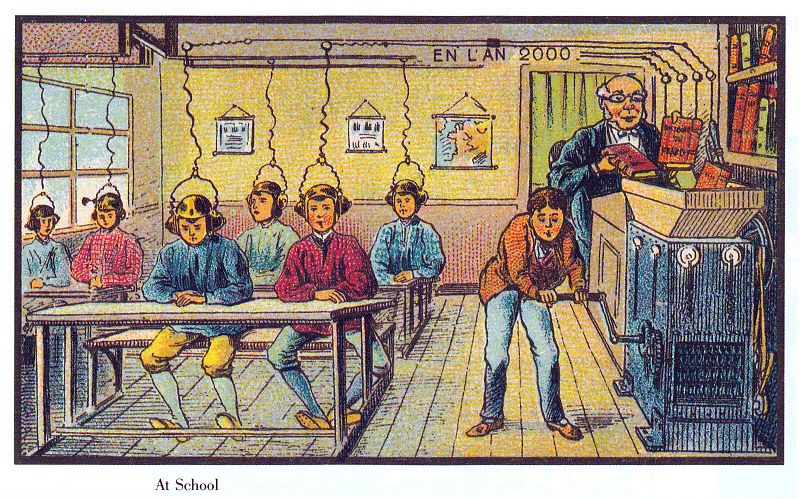 |
Jean-Marc Côté, A 19th-Century Vision of the Year 2000
|
On the first day (pre-conference), I attended a whole day Design Thinking workshop at the prestigious HPI Design thinking school. The challenge: Envision and design Post-Disciplinary Learning: Rethinking Educational Systems in a world where there are no more disciplines. We worked through a 2-phase process, first Problem Space (Understand + Observe + Point of View) and then Solution Space (Ideation, Prototyping and Test), brainstorming, interviewing, analysing, clustering, prototyping and so on. You can learn more about the methodology here and do consider it if you are dealing with complex challenges where potentially disruptive, multi-disciplinary approaches/solutions are needed. Keep in mind thought that an experienced facilitator is key to Design thinking.
In my past work, I had the opportunity to work with the Institute for the Study of Knowledge Management, ISKME (California) which delivers what they call Action Collabs and I must say that their version of a design thinking workshop felt more conducive to the sort of creative thinking that leads to innovating ideas. The Berlin facilitation version focused too much on the rigour of the process, instead of supporting the creative flow.
Moving on, what else drew my attention?
- the TUMO project session, a seemingly utopian, but very impressive after-school solution which works wonders for teens in Armenia at the moment, and it is expanding;
- Bryan Alexander's contributions - you can participate in his monthly online, participatory, open conversation about education, in the Future Trends in Technology and Education project. Bryan's a futurist...
- the Minerva project session, a global high-ed alternative that I'd like to learn more about.
OEB 2019 - Official Wrap-up video
On the last day, I dropped into the Blended Learning design session delivered by Nataša Perović and Clive Young from the University College London (UK). The room was full of excitement. They spoke about the same ABC methodology I had learned from them at OEB 2017. ABC is a visual storyboard approach for designing blended curriculums and it has in the past 2 years been used successfully various time in the meteorological training community.
The final session of the day for me, Learning cultures, emphasised an old, but important idea - how we, those working in learning and design need to stop acting like a hammer looking for a nail, but instead act as partners, working closely with those we are trying to serve; with a broad ecosystem approach in mind where training is not an universal panacea.
For more of an impression of the conversations that go on back at forth over the years at & around OEB such as if and to what extent we are ready to work with AI, if we are teaching the right skills for the future, and the role of workplace learning, check out #oeb2019 on Twitter.
How did others experience OEB2019?
- See Audrey Watter's reflection
- Donald Clark's reflection
- ... and I can't wait to read Tomislav Marekovic's reflection, my colleague from EUMETCAL who came along.
