Monday, 28 November 2022

Coming back to Online Educa Berlin in 2022

This November I had the pleasure to participate in person at the 28th annual global conference and exhibition on digital learning and training. The conference gathers annually thousands of learning professionals from 70+ countries. Despite being a global conference, it manages to maintain a cosy and friendly atmosphere, encouraging open discussions between education professionals from all sectors on shared opportunities, challenges and concerns.


OEB participation


As every year, the range of session formats included plenaries, presentation panels & debates to learning cafes, workshops, discovery demos and round table conversations.

Some of the most discussed topics included learning design & the human experience, making decisions with data, digital transformation, the metaverse & the future of learning, upskilling/reskilling & competences in the workplace.

Before discussing some of the sessions I participated in, here’s a quick list of useful links you may want to check out:

Pre-conference workshops

The first pre-conference workshop I attended was facilitated by Saul Carliner, Professor at Concordia University (Canada), who spoke about Curriculum design competency for L&D professionals. Using the Competency framework for L&D professionals developed by the Institute for Performance and Learning (Canada), we worked in groups to address the challenge: design curriculums for higher education, continuing education and corporate training. In our designs, we were prompted to address the following elements: curriculum requirements & potential issues, a list of courses we may want to include, as well as information that has to go in the curriculum proposal.


Saul Carliner on Curriculum design 

The second workshop of the day was offered by Carol Damm (Boston College, USA) and Melissa Kane (Brown University, USA). Entitled “Designing Humanistic Learning Experiences for Education, Training and Product Development”, the session aimed to engage participants in co-designing a framework redefining humanistic learner experiences for education, training or product development.

After an introductory exercise, the facilitators introduced the head - heart – hands perspective.

The head - heart – hands method & learning sciences

Next, the concept of Human-centered design was introduced and discussed from different perspectives/fields including industrial design, user experience design, anthropology and game design (see the images below).

After this introduction, we were split in groups and invited to select a case study and design a framework integrating the humanistic concepts introduced in the session.


Human-centered design from various perspectives

Opening plenary on 1st day of the conference

On the first day of the conference, the plenary was kicked off by David Mattin, journalist and founder of the New World Same Humans (UK), a newsletter on trends, technology and society. His talk focused on the capabilities of Virtual reality and AI, with impressive applications, such as a recent complex 27-hour surgery in Rio de Janeiro directed from a hospital in London. The almost 100 medical staff involved operated in the same "virtual reality room" together.

Another example was Replika, a controversial chatbot that simulates a human relationship powered by artificial intelligence (AI), combining a sophisticated neural network machine learning model and scripted dialogue content - GPT-3 – giving users the impression of being heard and understood.

Here is a recent interview with David where he talks about his work.

 Replika or the risks of advanced chatbots

Also in the opening plenary, Pär Lager (Swedish Defence University) spoke about how leaders should focus on what their organisations will look like in 5-10 years from now and how roles will change. The main points shared was that for roles which will stay, upskilling will be necessary, as they will become more complex. A series of new roles will also appear in organisations, making reskilling required - equipping staff with new knowledge and abilities. To do that, Pär suggested 5 steps for creating a successful learning culture:

1. Light the lighthouse – where are we as an organisation headed towards?
2. Learning mindset – when leaders embrace the need for learning it results in greater growth in their teams
3. Learning needs & learning policy – find out what the teams need and instill learning best practices into their organisation
4. Everyday learning - leaders who encourage learning before, after and on the job experience the greatest success
5. Education & training - create opportunities for in-depth learning through formal opportunities

More information on his approach is available in this article published on the Oslo Business Forum. 

enABLe – Active Blended Learning method for collaborative learning design

One of the most interactive sessions at the conference for me was Ale Armellini and Andy Cleff’s (University of Portsmouth, UK) learning café which introduced the enABLe method. The method builds on UCL’s ABC Learning Design method (see my 2019 post), as well as on Gilly Sander’s Carpe Diem and University of Northampton’s CAleRO method. The core principles of th emethod are detailed on the enABLe website. If you are interested in the application of the method, have a look at this Padlet. All resources there are available for download and licensed with Creative Commons.

Professor Ale Armellini introducing the enABLe principles

The 90-minute session at OEB was conceived as a team-building exercise to learning design using a series of activities, such as the articulation of our shared values and principles and a step-by-step collaborative approach to storyboarding and activity creation. It was fun, intuitive and unlike many other similar workshops, well scoped for the limited time we had together. See the slides.

The enABLe toolkit

Donald Clark on what research tells us about the Metaverse

One of the most exciting session was Donald Clark’s talk “Learning in VR and the Metaverse: Practical Pointers Based on the Research”. Donald took the audience through a history of learning from cave art to printing, touching upon the massive success of video games, the inevitable shift from 2D to 3D and the use of Virtual Reality (VR).

He continued by asking a number of important questions, such as, does VR increase learning? Does it lead to better learning? Does generative learning work in VR or does embodied learning matter? What about learning by doing and very importantly, to what extent is cognitive load a problem in VR?

To answer such questions he drew on older and more recent research, from the work of Richard Clark (2007) on games, discovery learning and cognitive overload to Guido Makransky’s recent work at the Virtual Learning Lab at the University of Copenhagen, who developed a research model for learning in immersive media taking into consideration factors such as interest, motivation, self-efficacy, embodiment, cognitive load and self-regulation.

Donald Clark on stage

If you need an introduction to the Metaverse, listen to this episode of Great Minds on Learning: VR & Metaverse with Donald Clark, a discussion conducted in a virtual world exploring “the thought of those who have tackled the practical and philosophical questions that learning in virtual worlds raises” from Lanier to Baudrillard and Mark Zuckerberg.

You may also be interested in his latest book Learning Experience Design: How to Create Effective Learning that Works from 2021 where Donald includes a reflection on a variety of topics from user experience to AI, learning analytics and learning theories.

He is active on his blog.

How to use Learning design & analytics in your own practice?

Bart Rienties from the Open University (UK) talked about their large scale adoption of predictive learning analytics at the OU since 2014. Integrating the Balanced Design Planning (BDP) created by the Learning Analytics Laboratory (LA Lab) from the University of Zagreb, the Open University makes use of an analytics dashboard tracking demographic data, time spent, use of resources, completion of activities, number of clicks, correlation with grades etc.

While such analytics can often predict with success course completion rates and future engagement, it’s still an open discussion to what extent they reveal useful information about learning; and to what extent this information can and should be used to inform course design and learner experience.

Access the slides here.

Open University on challenges from working with predictive learning analytics


For more on OEB, check out #oeb2022 on Twitter and keep an eye on the resources available at their website. 


Wednesday, 2 June 2021

Welcome to CALMet XIV!


CALMet XIV 

27 September - 1 October, 2021 

Online, hosted by Servicio Meteorológico Nacional, Argentina

Third Announcement 


Conference registration is now closed.
 

If you have any questions please contact: organizers@calmet.org


Friday, 5 March 2021

CALMet XIV 2021 - Second Announcement


 CALMet XIV will be hosted by Servicio Meteorológico Nacional, Argentina, on 27 September - 1 October 2021. This entirely online conference will offer a venue to find what we have learned and what future impacts this will have for the hydro-meteorological training. It will also encourage practitioners in the education and training sector to discuss, debate and share views and techniques on the challenges / opportunities arising from the following sub-themes: Education and Training Challenges and Opportunities,
Online Teaching and Learning, Collaboration.


In 2021 CALMet will offer a new, more active event - a “flipped-learning conference.” Rather than a series of presentations, we intend this event to be highly active and filled with opportunities for participants to interact. This is because we are asking for the presentation materials to be posted and reviewed in advance, leaving the valuable conference time to probe, question and discuss more than ever before. The Second Announcement is now available for more information and abstract submission.

Read the Second Announcement   

Monday, 23 November 2020

 I am presenting the linked presentation next week at the 2020 Online Educa Berlin Conference. "Trainers Without Borders" is about what trainers can do to have even deeper impacts with our learners.

I have believed for a long time that training is more than what happens in classrooms, and more than what is controlled by trainers. It is an everyday, all day, lifetime activity. What we know is the result of our interactions with not just educators, but also our colleagues and our living and working environments each day. Research supports this again and again, as well as everyday parlance ("live and learn," "experience is the best teacher," "learning by doing").  Trainers have an opportunity here: we can cross borders and impact learners in more ways than is traditional. If we try, we can build learning ecosystems, not just courses. We can create sustainable learning.

The presentation linked here explores the trajectory of learning theories through history, toward a convergence on ecological perspectives, driven by increased emphasis on systems theory and complexity. Principles of ecological theories and applications in our CALMet communities are also offered.

https://youtu.be/y7KcJgfW9Nk

Monday, 11 May 2020

Let’s learn from each other!!

Sometimes you happen to be part of a great WhatsApp group that is called Design Discussions where some invitations for good webinars came by. We shared these invitations with the community. Then I was pushed by the Eumetcal community to put all the available resources from these webinars on one easy to find place. For me this was the trigger to create a “Support for the community” page on the CALMet Commons with all the great resources that were shared between the members in the WhatsApp Design Discussions group and were found in the rest of the community. 

Our plan is to keep this page updated with the new resources we find. Therefore we hope that you will also share with me your suggestions for training material, articles, books and tools which makes your live easier and could be handy for others within our community to use as well. Then I will make sure that this information will be put on the page. In the end we hope that this will help to make your job easier.

Friday, 6 December 2019

My time at Online Educa Berlin 2019

This past November I had the privilege to attend the Online Educa Berlin (OEB) 2019 annual conference. It's a privilege really, as these conference are not cheap, considering besides fees, the time away from the office and the alternative: free, online excellent resources and events (see the ALT Online Winter Conference 2019 or the Open Education Week). I go to OEB for the few, but excellent sessions that encourage critical thinking, the a-ha moments or, according to the Brain Ladies, the light bulb moments when gamma waves activity supports intensive bursts of higher-order thinking. 
The light bulb moment for me this year happened during: 
  • Audrey Watters’ keynote - on edtech propaganda, dystopian futures, ideology and myths. Audrey sees herself as a Kassandra of the edtech world and writes nicely at http://hackeducation.com;
  • Mike Sharples' session - drawing on his Open University (OU) experience or that of designing FutureLearn, he talked about pedagogy-based design, citizen inquiry, promoted his new book, Practical Pedagogy, and the annual OU Innovating Pedagogy reports, a correspondent of the EDUCAUSE's Horizon Reports;
  • Brain Ladies' lively, humorous and playful session from 4 researcher ladies on neuro-science, AI and learning. Online workshops to be offered starting next January;
  • Nik Gowing's scary session on thinking the unthinkable reflecting the findings of his study on leadership, global anxieties and disruptions (read more on that). At OEB, Nik warned educators  about the necessity to prepare for what is to come - the unforeseeable.
  • Donald Clark sessions on both the pedagogy behind videos (or why they are not enough for deep learning) and predictable AI sessions, while promoting some of his AI or sort of AI work, see CogBooks. His talk was preceded by a lovely presentation by Mathew Day from ESA who showed us how they've been using videos to train astronauts up at the International Space Station.

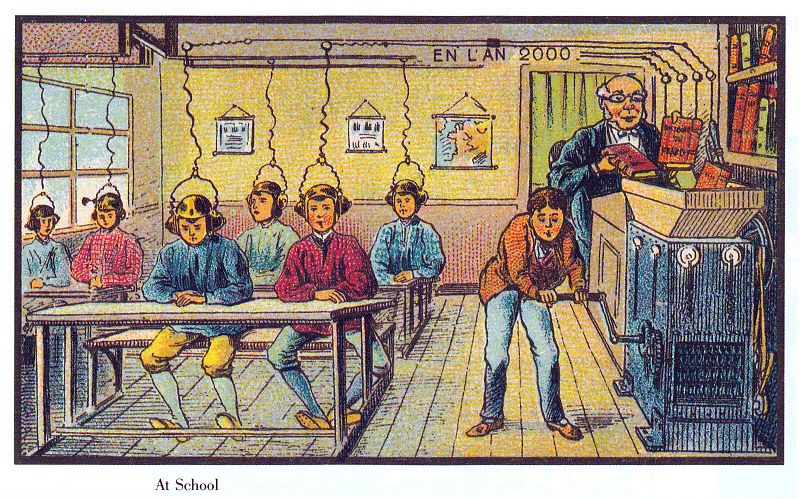
Jean-Marc Côté, A 19th-Century Vision of the Year 2000
On the first day (pre-conference), I attended a whole day Design Thinking workshop at the prestigious HPI Design thinking school. The challenge: Envision and design Post-Disciplinary Learning: Rethinking Educational Systems in a world where there are no more disciplines. We worked through a 2-phase process, first Problem Space (Understand + Observe + Point of View) and then Solution Space (Ideation, Prototyping and Test), brainstorming, interviewing, analysing, clustering, prototyping and so on. You can learn more about the methodology here and do consider it if you are dealing with complex challenges where potentially disruptive, multi-disciplinary approaches/solutions are needed. Keep in mind thought that an experienced facilitator is key to Design thinking. 

In my past work, I had the opportunity to work with the Institute for the Study of Knowledge Management, ISKME (California) which delivers what they call Action Collabs and I must say that their version of a design thinking workshop felt more conducive to the sort of creative thinking that leads to innovating ideas. The Berlin facilitation version focused too much on the rigour of the process, instead of supporting the creative flow.
Moving on, what else drew my attention?

OEB 2019 - Official Wrap-up video 
On the last day, I dropped into the Blended Learning design session delivered by Nataša Perović and Clive Young from the University College London (UK). The room was full of excitement. They spoke about the same ABC methodology I had learned from them at OEB 2017. ABC is a visual storyboard approach for designing blended curriculums and it has in the past 2 years been used successfully various time in the meteorological training community. 
The final session of the day for me, Learning cultures, emphasised an old, but important idea - how we, those working in learning and design need to stop acting like a hammer looking for a nail, but instead act as partners, working closely with those we are trying to serve; with a broad ecosystem approach in mind where training is not an universal panacea. 
For more of an impression of the conversations that go on back at forth over the years at & around OEB such as if and to what extent we are ready to work with AI, if we are teaching the right skills for the future, and the role of workplace learning, check out #oeb2019 on Twitter. 
How did others experience OEB2019?
  • See Audrey Watter's reflection
  • Donald Clark's reflection
  • ... and I can't wait to read Tomislav Marekovic's reflection, my colleague from EUMETCAL who came along. 


Thursday, 10 October 2019

What produces better learning outcomes: classroom instruction or e-learning?

This is a question that I encounter often in my work as an Instructional Designer for the COMET program.  Based on my current understanding, my answer is - the instructional event that uses effective learning methods.  Some of those methods include realistic decision making, spaced repetitions, real-world contexts, and feedback.

In my experience, the key method that brings them all together was summarized nicely by Michael Allen: 

“To learn is an action taken by and occurring within the learner. Instructors cannot learn for their learners, and neither can e-learning technology even with all its graphics, animations, effects, audio, interactivity, and so on. Learners must be active participants and, in the end, do the learning. Learner motivation determines the level of participation in learning activities and the degree to which learners will make the effort needed to learn.” (Allen, p.121)  I have found this to be useful for designing e-learning and classroom courses.

Our challenge as trainers is to create the conditions in which the learners will think about and take actions in order to learn.  Let’s say that we are training people how to diagnose a disease in a patient.  We can create a lecture about it in which the learners passively listen about how to make a diagnosis, about different symptoms and ask a few questions in the end.  Or we can bring in actors who have rehearsed a list of health symptoms and then ask every learner to go through the diagnosis process and determine what kind of disease this patient has. 

The lecture will likely diminish motivation in the learners and the action they are taking is listening (perhaps one or two  students get to ask a question).  The patient simulation could increase motivation because the learners are practicing what they need to learn and they will have to use their diagnosis and communication skills.  So a classroom lecture will not be enough to engage our learners in the actions to help them learn, but a classroom simulation will.

What if our budget did not allow us to create a classroom simulation?  We can create an online recording of the lecture and ask the learners to view it.  Based on my experience, this will also diminish learner motivation (imagine listening on one hour long lecture online) and the learners will not engage in the kinds of actions that help them learn.  We could create an online simulation in which learners listen to a patient, ask them questions, and then diagnose the disease.  They can then receive feedback on how to improve.  The learners will be thinking and taking actions to help them learn and receive feedback about their performance.  The learners will be able to take the simulation at any time of the day or night and as many times as they need.  This e-learning simulation will be much less expensive than the classroom simulation (no need to find actors and pay them every time, no need to deal with scheduling issues, etc.)

I hope you can see that it is possible to create ineffective and boring lectures and boring e-learning that do not create the environment for our learners to become “active participants and do the learning.”  It is also possible to create engaging classroom experiences and engaging e-learning if we carefully select and adapt our instructional strategies to the learners, the topic, the budget and all the other variables that make our work so challenging.

In 2017, Will Thalheimer reviewed numerous meta-analyses comparing classroom to e-learning and offered the following conclusions:

“In terms of learning effectiveness, it is NOT whether the modality is e-learning or classroom instruction; the learning methods are what make the difference. Realistic decision making, spaced repetitions, real-world contexts, and feedback—among other research-supported learning factors—produce better learning than straight information presentation.” 

Bernard et al. expressed a similar view after completing their impressively nuanced and detailed meta-analysis work on studies comparing classroom instruction to eLearning in 2004:

“it is the characteristics of instructional design, such as the instructional strategies that are used, the feedback that is provided, and the degree of learner engagement, that create the conditions within which purposive learning will occur... Characteristics of pedagogy tended to take precedence over media... This is especially true for achievement outcomes”

The last idea I wanted to share is about implementation.  It is very rare to be successful in our first attempt of using any instructional strategy.  It takes some experimentation and several iterations in order to refine our implementation to match our learners’ needs, in some instances, some learners may never be happy with our work.  It is important for us to reflect after every training event, learn from our mistakes, find additional ideas, and try again.  In this way, we are also learning how to create the conditions that help our learners become ““active participants and do the learning” after every event.

My academic advisor gave me very important advice early in my training to become an Instructional Designer.  He said “Designing training is a series of compromises.  The key is to find the set of compromises that will help people learn.  Choose the approach and medium that will best serve the instructional goals.”  In my experience, I have found that the choices and compromises change with every audience, method, topic, budget, and delivery media.


References
Allen, M., Sites, R. (2012). Michael Allen's Guide to e-Learning: Building Interactive, Fun, and Effective Learning Programs for Any Company, 2nd Edition. ATD Press Wiley, Inc. 
Bernard, R.M. Abrami, P. C. Lou, Y., Borokhovski, E., Wade, A. Wozney, L., Wallet, P. A., Fiset, M., Huang, B., (2004). How Does Distance Education Compare to Classroom Instruction? A Meta-Analysis of Empirical Literature    Review of Educational Research, p. 35/63.
Thalheimer, W. (2017). Does elearning work? What the scientific research says! Available at http://www.work-learning.com/catalog.html.

Tuesday, 23 October 2018

Join us for EUMETCAL/CALMet XIII 2019 in Darmstadt, Germany!


17 - 20 September Darmstadt, Germany
Hosted by EUMETSAT

Join the international CALMet/Eumetcal community for four days of sharing best practices in training for the meteorological, hydrologic, and climate workforce. EUMETSAT will host the 13th biennial, in-person gathering. The themes are:

Training challenges and opportunities
- The future roles of personnel providing weather, water, climate and oceanographic services;
- New sources of data, such as satellite, and new sources of decision support, such as enhanced NWP and nowcasting systems, and their impact to the training needs;
- Changing standards, course content and delivery to prepare the workforce for the new service roles;
- Adapting courses and learning to address the WMO qualification and competency requirements;
- Using virtual reality and /or augmented reality in training; 
- Using training to develop and maintain communities of practice.

Teaching and learning
- Best practices in implementing learning and development activities;
- Motivating the learner for now and the future;
- Misconceptions and myths about learning;
- Lessons learnt from evaluation of training programmes;
- Advanced teaching and training techniques;
- Interactive online learning;
- Increasing the long term impacts of training initiatives;
- Improving the connection between initial education and work based training.

Collaboration
- Identifying opportunities for shared education and training;
- Ensuring all countries can prepare their workforces for the changing services through international collaboration and cooperation opportunities.

Please read more about the event at Conference Web Site. The registration is CLOSED. We are looking forward to seeing you in Darmstadt!